Small peptide therapeutics are one of the fastest-growing segments in drug development and manufacturing, driven by the explosive success of GLP-1 receptor agonists and a deep pipeline of candidates across metabolic disease, oncology, and beyond. These molecules can be produced either biologically (i.e. through recombinant expression systems) or chemically (i.e. via solid-phase peptide synthesis (SPPS)). This distinction matters not just to drug developers, but to the broader drug manufacturing market: as peptide drug volumes scale, demand surges for the reagents, instrumentation, contract manufacturing capacity, and analytical workflows that underpin both approaches.
Similar Peptide Drugs, Different Manufacturing Approach
Semaglutide and tirzapetide, are both blockbuster drugs for diabetes & weight loss. Both are GLP-1 agonists, but are synthesized differently. Novo Nordisk's semaglutide is produced at scale via a hybrid biological-chemical process1, while Eli Lilly’s tirzepatide is chemically synthesized2.
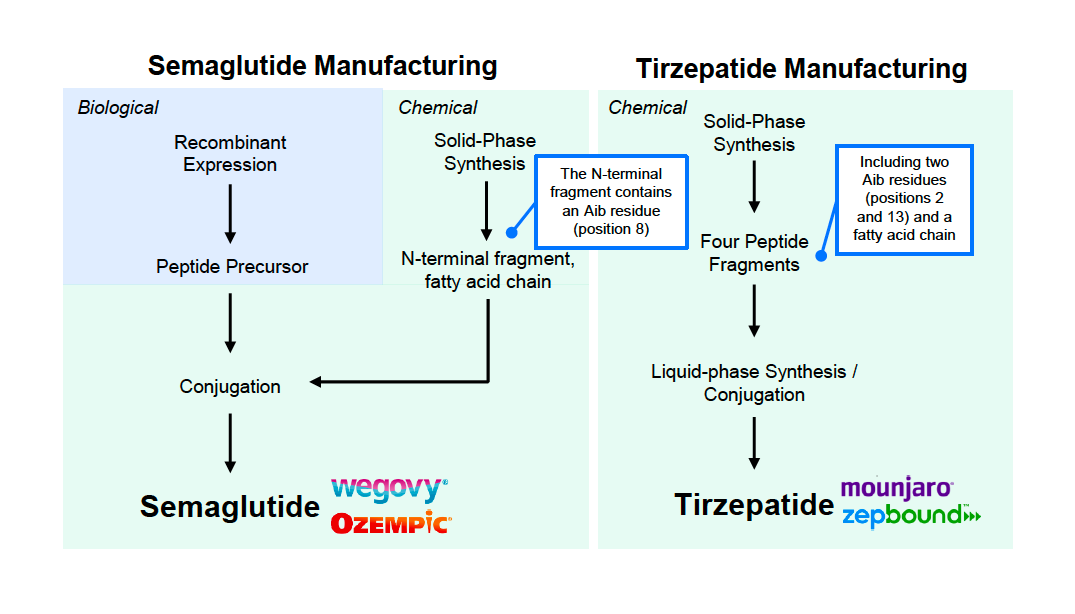
For semaglutide, a peptide precursor ‘backbone’ is recombinantly expressed in yeast, which is then modified with an N-terminal fragment (which includes one noncanonical amino acid) and a fatty acid linker. Tirzapatide relies on solid-phase synthesis (SPPS), with 4 fragments individually synthesized before being conjugated together.
Recombinant (i.e. biological) expression is cost-effective for large volumes (e.g., insulin, the iconic small peptide drug, is produced almost exclusively from recombinant expression). So why aren’t both semaglutide and tirzapetide produced recombinantly?
There are many potential/partial explanations for this difference:
- Tirzepatide is a dual agonist (for GIP/GLP-1), making it an arguably more structurally complex molecule and less tenable for recombinant expression (though both are linear peptides with a side chain).
- The 2 non-canonical amino acids (Aib*) in tirzapetide, versus the 1 in semaglutide, makes it more difficult to recombinantly express. Non-canonical amino acids are difficult to reliably incorporate in a recombinant expression system; the more ncAAs = the more barriers to recombinant expression.
- Other context-specific reasons are governing decisions to [not] manufacture via recombinant expression (e.g., existing infrastructure / expertise [though both Eli Lilly and Novo Nordisk recombinantly express insulin]).
Patterns in Recently Approved Drugs:
We profiled recently approved small peptide therapies to examine whether amino acid length, molecular weight, and structural complexity** might predict manufacturing routes. A clear pattern emerges: all three – amino acid length, molecular weight, and structural complexity – track with whether a drug is made recombinantly or chemically synthesized.

Recombinant vs Chemical:
- Chemical synthesis is far more common: most (31 / 38) of the recently approved small peptide drugs are chemically synthesized. The remaining 7 have some components that are recombinantly expressed. All incorporate subsequent chemical modifications to a peptide backbone (similar to semaglutide’s manufacturing process).
Length & Weight:
- Of recombinantly expressed peptides, the average molecular weight is >4 kDa, and ~28 amino acids (a.a.) long; chemically synthesized peptides tend to be smaller, with an average molecular weight of <2 kDa and ~13 amino acids long.
- Expectedly, length / molecular weight are clear determinants for production method: longer peptides are more likely to be recombinantly expressed, while shorter peptides are typically chemically synthesized. Chemical synthesis methods are most compatible for shorter peptides (typically <30 a.a.); longer than 30 a.a. starts to impact reliability and yield.
Cyclic vs Linear Structure:
- Of the 38 drugs profiled, 18 are cyclic and the remaining 20 are linear. All of the 7 recombinantly expressed proteins are linear, while all but 3 of 18 cyclic peptides are synthesized chemically. The select group of 3 cyclic peptide antibiotics (rezafungin, dalbavancin, oritavancin) leverage bacterium-produced precursors before subsequent modification.
- Voclosporin is an interesting exception; it is considered chemically synthesized despite its precursor, ciclosporin, being biologically produced. Cyclosporin is an established drug already and available from pharmacopoeias.
Other Factors that Impact Manufacturing Route:
Non-natural Complexity: Peptide complexity is a major determinant for manufacturing approach. Chemical synthesis allows for the incorporation of non-natural amino acids and modifications (e.g., PEGylation, lipidation), offering greater design flexibility. Recombinant production is generally limited to the 20 canonical amino acids unless advanced genetic/enzymatic engineering is used; non-natural modifications are very limited. Because of this limited ‘tool-kit’ of recombinant production, it is often paired with downstream chemical (or enzymatic) steps to add non-natural modifications
While we did capture whether peptides are cyclical or linear, we did not look at more granular features (e.g., non-canonical amino acids, site-specific modifications). We can already look at tirzepatide vs semaglutide as an example of how peptide complexity (i.e. non-canonical amino acids) might drive the need for chemical synthesis.
Cost and Scale: Chemical synthesis is suited for producing small to medium quantities efficiently and with high purity, driving some preference during manufacturing for clinical trials and for therapies of smaller indications. Recombinant typically becomes more cost-effective and scalable for large quantities, especially for longer peptide sequences (where chemical synthesis starts to become inconsistent).
Waste and Environmental Impact: Chemical peptide synthesis is inherently solvent-intensive. For SPPS, every addition of an amino acid requires repeated washing steps, generating large volumes of hazardous solvent waste. At commercial scale, this translates into significant waste volume that must be treated, recovered, or disposed of. Increasingly, this is a key cost, environmental, and regulatory liability the industry is under pressure to address.
Development Speed and Consistency: Chemical synthesis is generally and highly reproducible, faster for straightforward, short peptides. Biological synthesis requires more development time to set up the strains and scale.
Other Factors: Impurities / contaminant considerations and existing infrastructure are other factors at play.
The Current State and Future of Peptide Manufacturing
Chemical synthesis seems to be the preferred means for small peptide manufacturing, evident in manufacturing choice of recently approved therapies. For most small peptides, solid-phase peptide synthesis (SPPS) remains a practical and flexible approach, offering access to non-natural modifications and greater process predictability. That said, at commercial scale, recombinant production can offer a major cost advantage over chemical synthesis, which requires expensive protected amino acid building blocks and coupling reagents.
Looking ahead, there are opposing regulatory forces acting upon chemical peptide synthesis. In 2021, the FDA issued guidance expecting generic peptide drugs to be produced chemically3, signaling that chemical synthesis could be the regulatory default for this drug class.
Yet, tightening chemical regulations are emerging as a headwind for large-scale chemical manufacturing. In December 2023, the European Commission restricted the use of two of the most widely used SPPS solvents, DMF4 and NMP5, due to their reproductive toxicity. In the US, similar dynamics are playing out: the EPA added DMAC, a close structural analog of DMF, to its hazardous substances list in 2024. Both dynamics add to a challenging sustainability profile for chemical synthesis, raising the operating costs and shifting the calculus toward greener synthesis routes and / or recombinant expression.
The industry is adapting to these changes. For chemical synthesis, innovation is focused on reducing solvent volumes, finding greener reagent alternatives, and redesigning the process to be less wasteful (e.g, flow chemistry, microwave-assisted SPPS). On the biological side, companies are developing ways to better incorporate ncAAs peptides recombinantly (e.g., Constructive Bio) or optimizing cell-free expression systems to rival the cost-efficiency / scale of cell-based systems (e.g., Isomerase). Small peptide recombinant expression is also buoyed by the efficiencies of the bioprocessing space at large (e.g., process intensification, single-use systems, continuous bioprocessing – see our Bioprocessing Report for more insights!).
As the peptide therapeutics market accelerates toward the $100 billion mark, the manufacturing decision between chemical synthesis or recombinant expression is becoming increasingly important. These decisions continue to have major implications on which corner of the life sciences tools and services space captures the most value: do the large bioprocessing platform players (e.g., Thermo Fisher, Cytiva, Sartorius) see an uplift, or do the specialized peptide synthesis equipment vendors and CDMOs benefit most (e.g., CEM Corporation, AAPPTec, Bachem, PolyPeptide)? How do emerging regulations and innovative players change the landscape? These are the questions worth watching as the next wave of peptide therapeutics moves from pipeline to market.
Method Notes:
We built out a database of recently approved peptides, using a recent review as a starting point and adding recent FDA approvals. Notable exclusions include antibodies, label expansion, biosimilars. The line between peptide and protein is blurry: while the FDA uses a conservative cut off of 40 a.a., this would exclude insulin (~51 a.a.). We also consider Natpara, a parathyroid hormone, as a small peptide (84 a.a.); this was discontinued in 2024.
Notes:
* 2-Aminoisobutyric acid
** excluding other moieties (e.g., PEG)
Key Sources:
2: https://pubs.acs.org/doi/10.1021/acs.oprd.1c00108
4: https://eur-lex.europa.eu/legal-content/EN/TXT/?uri=uriserv:OJ.L_.2021.415.01.0016.01.ENG
5: https://eur-lex.europa.eu/legal-content/EN/TXT/PDF/?uri=CELEX:32018R0588&from=EN
Comments and opinions expressed by interviewees are their own and do not represent or reflect the opinions, policies, or positions of DeciBio Consulting or have its endorsement. Note: DeciBio Consulting, its employees or owners, or our guests may hold assets discussed in this article/episode. This article/blog/episode does not provide investment advice, and is intended for informational and entertainment purposes only. You should do your own research and make your own independent decisions when considering any financial transactions.
.png)

.png)
.png)